
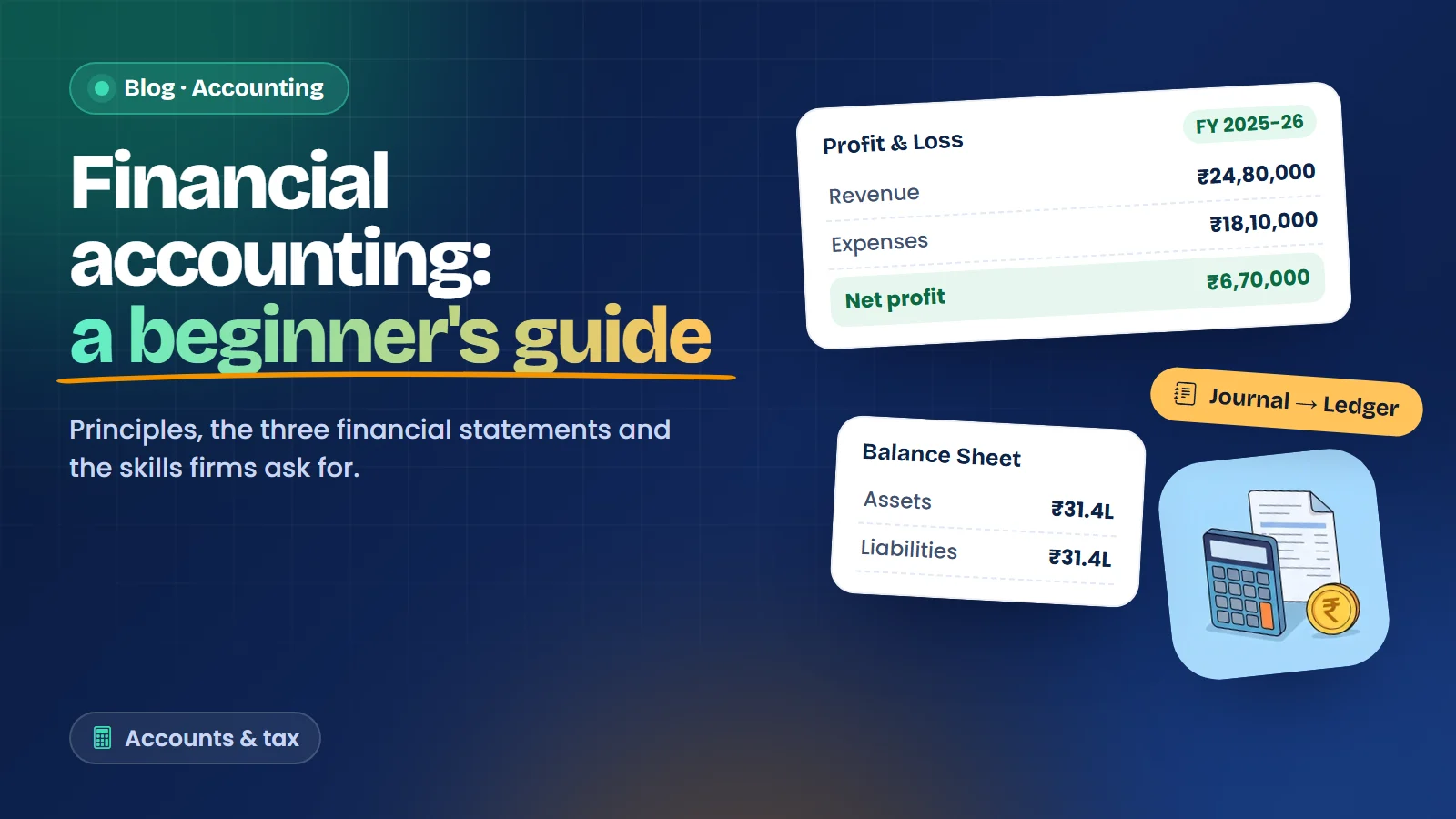
Learn the basics of accounting: the main rules, Profit and Loss, Balance Sheet, Cash Flow, the accounting cycle and the jobs it leads to.
Financial accounting is the backbone of every business decision. It is the discipline of recording, classifying, summarising and reporting an organisation's financial transactions so that owners, investors, lenders, tax authorities and regulators can understand exactly how the business is performing. If you are building a career as an enterprise accountant in India, a strong grip on financial accounting is non-negotiable — it is the foundation on which taxation, auditing, MIS and financial analysis are built.
What is financial accounting?
Financial accounting is the process of preparing standardised financial statements that report a company's results to people outside the day-to-day management — shareholders, banks, GST and income-tax departments, and the Registrar of Companies. Unlike internal notes or estimates, financial accounting follows agreed rules (in India, the Accounting Standards and Ind AS) so that one company's numbers can be compared fairly with another's.
In short: bookkeeping records the transactions; financial accounting turns those records into trustworthy statements that tell the financial story of the business for a given period.
The core principles you must know
- Double-entry system: every transaction affects at least two accounts — one debit and one credit — and the two always balance.
- Accrual concept: income and expenses are recorded when they are earned or incurred, not only when cash moves.
- Going concern: accounts assume the business will continue operating for the foreseeable future.
- Consistency: the same methods are applied period after period so results stay comparable.
- Prudence: anticipate losses, never overstate profits or assets.
- Matching: expenses are matched to the revenue they helped generate in the same period.
The three financial statements
Financial accounting produces three primary statements, and an enterprise accountant must be able to prepare and read all three:
1. Profit & Loss (Income Statement)
Shows revenue, expenses and the resulting profit or loss over a period. It answers: did the business make money?
2. Balance Sheet
A snapshot of what the business owns (assets) and owes (liabilities), plus owners' equity, on a specific date. It answers: what is the business worth right now? Assets always equal Liabilities plus Equity.
3. Cash Flow Statement
Tracks the actual movement of cash across operating, investing and financing activities. A company can be profitable on paper yet run out of cash — this statement reveals that.
The accounting cycle, step by step
- Identify and record transactions in the journal (journal entries).
- Post entries to the ledger accounts.
- Prepare the trial balance to check debits equal credits.
- Pass adjusting entries (depreciation, accruals, prepayments, closing stock).
- Prepare the adjusted trial balance.
- Draw up the Profit & Loss and Balance Sheet.
- Close the books and carry balances forward.
Mastering this cycle end-to-end is what separates a data-entry operator from a genuine accountant.
Financial accounting vs management accounting
They are often confused, but the difference is simple:
- Financial accounting looks backward and outward — historical, standardised statements for external stakeholders.
- Management accounting looks forward and inward — budgets, forecasts and cost analysis for managers to make decisions.
A well-rounded enterprise accountant uses financial accounting for compliance and management accounting for strategy.
Key concepts every enterprise accountant should master
- Journals, ledgers, subsidiary books and the trial balance.
- Depreciation methods (straight-line and written-down value) and their impact on profit.
- Provisions, reserves and the treatment of bad debts.
- Bank reconciliation statements.
- Ind AS / Accounting Standards basics and statutory compliance.
- Linkage with GST and TDS so that books stay compliant and audit-ready.
Tools of the trade
In real Indian workplaces, financial accounting is done with software, not paper. The essential toolkit includes Tally for day-to-day books, advanced Excel for schedules and analysis, and increasingly Power BI for reporting dashboards. Comfort with these tools is exactly what employers screen for.
Who should learn financial accounting?
Commerce graduates, working accountants who want to formalise their skills, small-business owners who manage their own books, and anyone targeting roles such as Accounts Executive, Accountant, Finance Associate or Audit Assistant. You do not need to be a chartered accountant to build a strong, well-paid accounting career — you need practical, job-ready financial accounting skills.
The three golden rules of accounting
Before the statements make sense, the golden rules of double-entry must be second nature. They tell you which account to debit and which to credit:
- Personal accounts: Debit the receiver, credit the giver.
- Real accounts (assets): Debit what comes in, credit what goes out.
- Nominal accounts (incomes/expenses): Debit all expenses and losses, credit all incomes and gains.
Every journal entry you ever pass is an application of these three rules. Once they are automatic, financial accounting stops feeling like memorisation and starts feeling like logic.
A quick worked example
Suppose a business buys office furniture worth Rs 50,000 in cash. Two accounts are affected: Furniture (an asset, real account) and Cash (also an asset). Furniture comes in, so we debit Furniture Rs 50,000; cash goes out, so we credit Cash Rs 50,000. The entry balances, the trial balance stays equal, and the Balance Sheet simply swaps one asset for another. Now imagine the same furniture bought on credit from a supplier — the credit goes to the supplier's account (a liability) instead of Cash. Small change in the transaction, clear change in the entry. This is the everyday work of financial accounting.
Ind AS and Indian accounting standards
Indian companies prepare accounts under notified Accounting Standards, and larger companies under Ind AS (converged with global IFRS). These standards govern how revenue is recognised, how assets are valued, how leases and provisions are treated, and what must be disclosed. An enterprise accountant does not need to memorise every standard, but must understand the framework, apply the common ones correctly, and know when to seek specialist advice. Compliance with these standards is what makes financial statements legally acceptable and audit-ready.
Common financial accounting mistakes to avoid
- Mixing personal and business transactions in the same books.
- Ignoring the accrual concept and recording only cash movements.
- Forgetting adjusting entries — depreciation, prepaid expenses, outstanding liabilities and closing stock.
- Not reconciling the bank statement with the cash book regularly.
- Poor documentation, which fails at audit and during GST or income-tax scrutiny.
Avoiding these keeps the books clean, the statements reliable and the business out of trouble with regulators.
Career roles that start with financial accounting
Solid financial accounting opens a clear ladder of roles. Typical entry points include Accounts Executive and Junior Accountant, handling books, invoices and reconciliations. With experience come roles such as Accountant, Finance Associate, Accounts Manager and Audit Assistant, taking ownership of monthly closing, statutory compliance and reporting. Every one of these roles rests on the same financial accounting foundation — which is exactly why it is the first thing employers test.
Learn it hands-on
If you want to go from theory to a job-ready skill set, the Certified Enterprise Accountant at F1 Macro Technologies covers financial accounting alongside GST, TDS, Tally, advanced Excel and MIS reporting — the complete stack an enterprise accountant uses every day. You can learn in the classroom or online, with hands-on practice on real business scenarios.
Conclusion
Financial accounting is where every accounting career begins. Get the principles, the three statements and the accounting cycle right, pair them with Tally and Excel, and you have a foundation that supports taxation, auditing and analysis for the rest of your career. The next step is simple: pick a structured program, practise on real entries, and keep building.
Frequently asked questions
What is financial accounting in simple words?
What is the difference between financial accounting and management accounting?
What are the three main financial statements?
Is financial accounting difficult to learn?
Which software is used for financial accounting in India?
 Course for this topicCertified Enterprise Accountant 80 Hours - 200 Hours
View course